
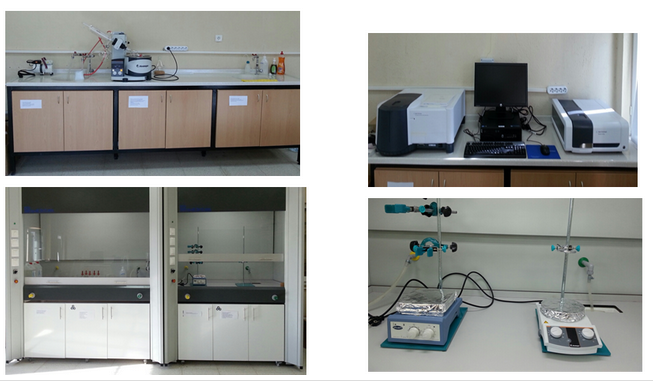
The Biomaterials and Supramolecular Laboratory was established in July 2013 under the TÜBİTAK 3501 project.
Research areas:
Photodynamic Therapy (PDT): PDT is a method aimed at destroying cancer cells without the need for surgical intervention. Three key elements are required to implement this method: light, oxygen and a light-sensitive substance. In cancer treatment using the PDT method, after the light-sensitive substance is taken up by the cancerous cell, it is excited by light of the appropriate wavelength. The energy of the excited substance is transferred to molecular oxygen, one of the surrounding molecules, via an inter-system transition. With the energy absorbed by molecular oxygen, the oxygen molecule in the triplet state is converted into a singlet-state oxygen molecule—a reactive oxygen species that has a toxic effect on cells—and the cancerous tissue is destroyed.
Chemical Sensors: It is well known that metal ions such as iron, zinc, mercury, fluoride and copper are of significant biological and environmental importance. For example, the copper ion is the third most abundant heavy metal in the human body after Fe³⁺ and Zn²⁺, and plays a key role in many physiological processes. It is essential for the activation of the oxygen molecule, which is vital for the survival of living organisms. Due to such significant effects, the detection of these ions has become imperative. Consequently, numerous important and novel fluorescent sensors have been investigated and reported in the literature.
Molecular Logic Circuits: Microprocessors are the brains of computers and consist of millions of transistors. As the size of the transistors used in microprocessors decreases, the speed and performance of the microprocessor increase. However, it is believed that we are gradually approaching the limit of how small transistor sizes can be made. If this prediction holds true, transistors will reach this limit within 20 years. In fact, the existence of such a limit had been foreseen by Moore long ago. In response to this prediction, in 1994 De Silva began working on molecular-level logic gates that could serve as alternatives to silicon-based analogues, attracting significant attention, as it does not currently appear possible to produce silicon-based equivalents at such a small scale.
Numerous articles on this subject have been published in reputable journals.
Responsible: Prof. Dr Zeynep EKMEKÇİ
zeynepekmekci@isparta.edu.tr